

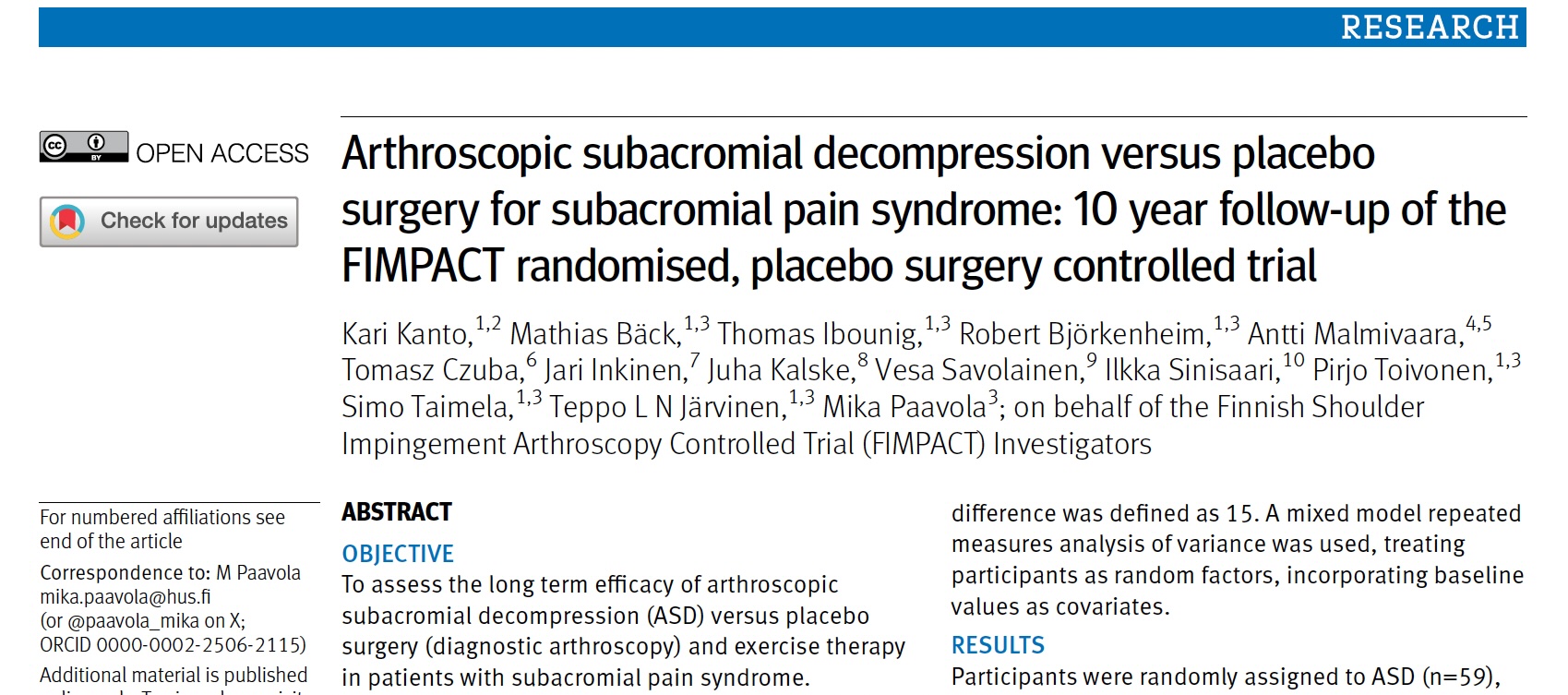
Today FICEBO celebrates an important milestone by publishing the ten-year follow-up study of the groundbreaking FIMPACT Trial (Finnish Subacromial Impingement Arthroscopy Controlled Trial), in the BMJ. Planning for the study began back in 2002 when Mika Paavola, an orthopaedic resident at the time, urged the team to consider putting subacromial decompression to the test. Recruitment started in earnest in 2005 and the two-year results were published in the BMJ in 2018. The five-year follow-up was published in 2020 in the British Journal of Sports Medicine. These results influenced international recommendations around ASD, leading some health authorities to consider that the best treatment approach is to prioritize non-surgical options first.
Arthroscopic Subacromial Decompression (ASD) is a minimally invasive procedure to treat shoulder impingement syndrome by shaving bone spurs or inflamed tissue under the acromion to relieve rotator cuff pressure.
Despite systematic reviews and meta-analyses of randomised controlled trials consistently showing that ASD versus exercise therapy or placebo surgery provides no short-term improvement in shoulder pain, the procedure is still widely done. It’s one of the most common shoulder surgeries (e.g., ~30,000 annually in the UK NHS alone and up to 250,000 done in the USA every year) even as its value has often been called into question.

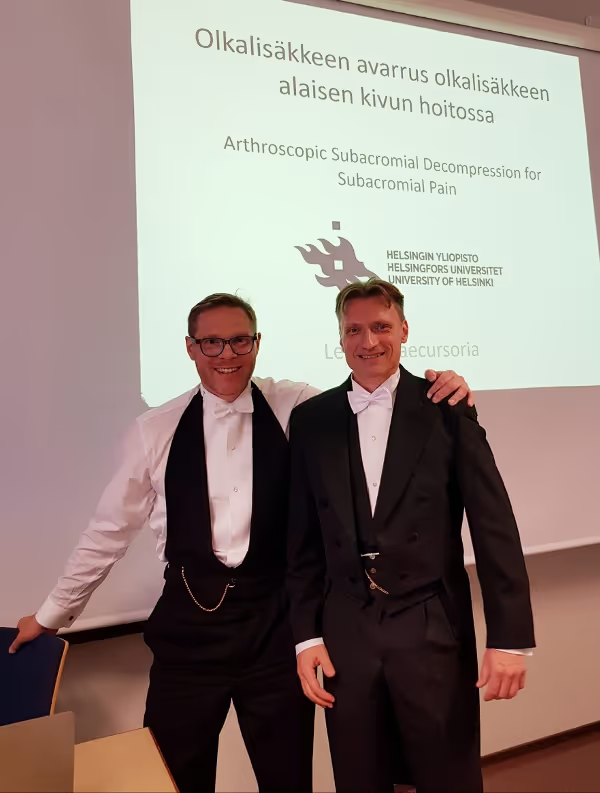
FIMPACT was the first placebo-controlled surgical trial ever conducted in Finland, and one of the first globally in orthopaedics. It was the basis of the lead author Kari Kanto’s doctoral thesis and this study has already had substantial impact on the practices of ASD surgeries in Finland, where ASD surgeries are vanishingly rare. In Finland, ASD was removed from the Finnish national treatment guidelines for shoulder pain in 2014.
FIMPACT found that in patients with subacromial pain, arthroscopic subacromial decompression (ASD) showed no additional benefit over placebo surgery or exercise therapy at 10 years.
These results don’t surprise the researchers. Asked why he bothered doing a ten-year follow-up study, Dr. Kanto said there are still people who are unconvinced that ASD is of questionable value.
“There was the rationale that not treating shoulder impingement would lead to shoulder tears and degenerative tendons,” he said, “but with the ten-year follow-up you can’t argue that the long-term effects are there.”
The main message that this research brings is a reminder that even if a surgical procedure contains a compelling explanation of the mechanics of the repair, one always has to ask the question: “Compared to what?” ASD might, as one rationalized, “create more space,” but if it ultimately didn’t provide any additional pain relief or function, was it worth it?
In the case of shoulder impingement, physiotherapy, exercise and good old Father Time finds that symptoms often resolve with no surgical intervention whatsoever.
All treatment groups showed substantial and sustained improvement in pain and shoulder function during follow-up. These results clearly indicate that ASD does not provide meaningful clinical advantage in the long term.
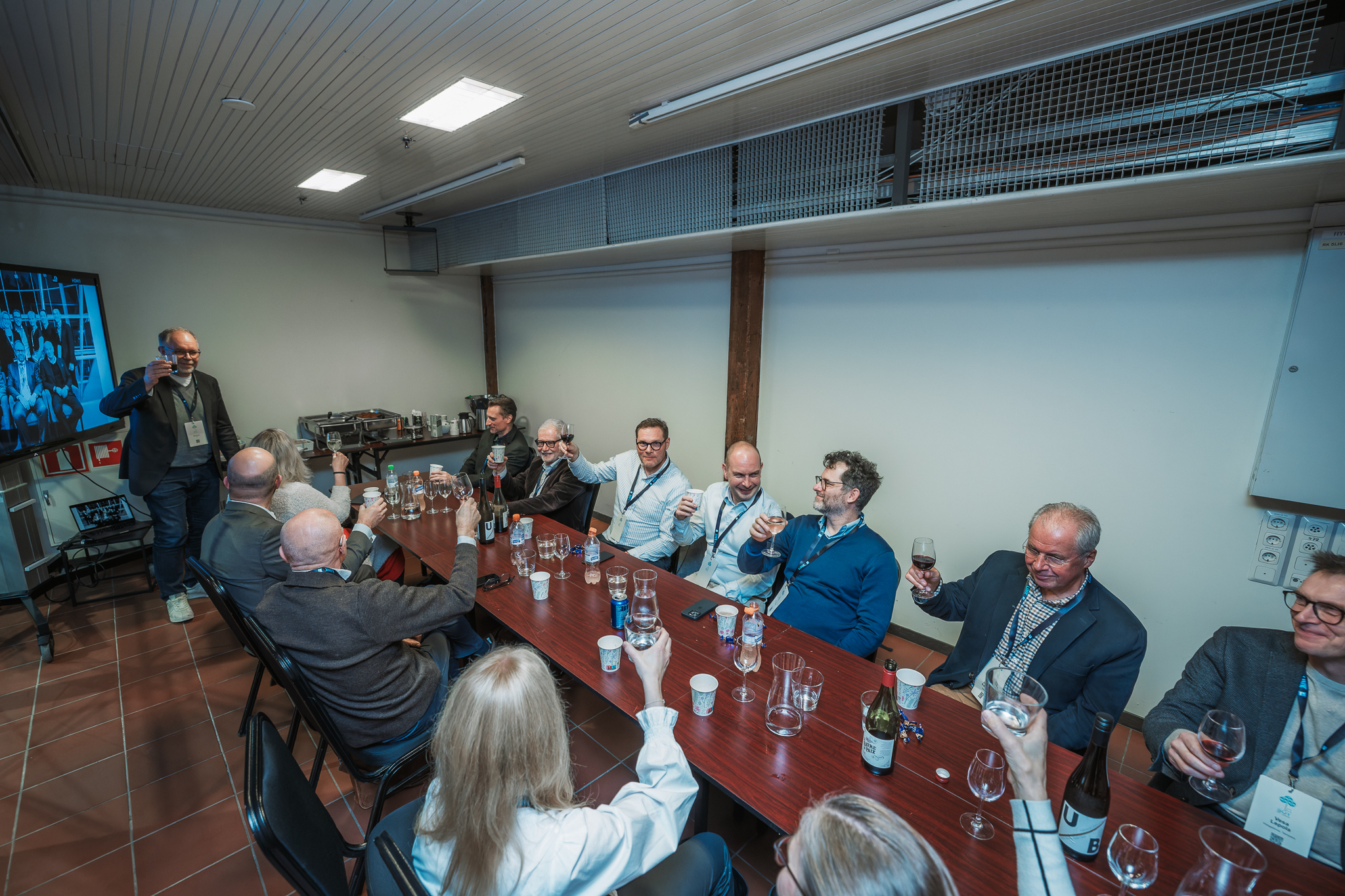
A cause for celebration! FICEBO members toast the success of the ten-year follow-up to the FIMPACT trial. Principal Investigator Mika Paavola asks the team to raise their glasses at a team meeting to mark this important milestone. Photo includes Kari Kanto, Simo Taimela, Teppo Järvinen and other FICEBO staff and researchers.

Stay up to date
Follow FICEBO on social media to stay in the loop with our latest updates.
