




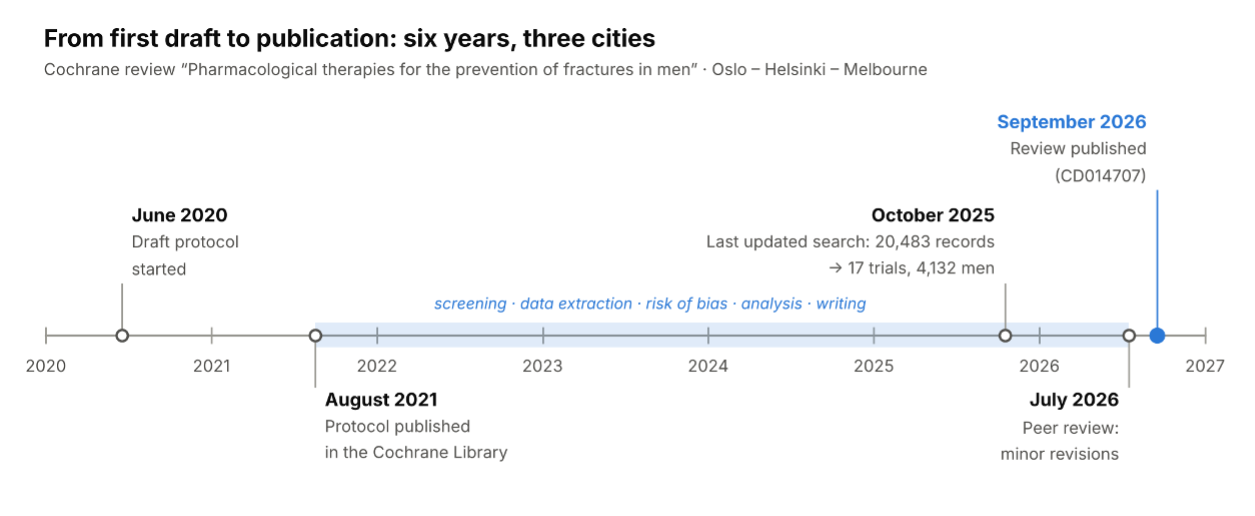
Five years ago, when our protocol was published, we wrote here about our new collaboration with Cochrane and Monash University – and ended the story with “Stay tuned!”. Today we can finally close that loop. Our Cochrane review “Pharmacological therapies for the prevention of fractures in men” was published in September 2026. It is the result of six years of joint work between Oslo, Helsinki and Melbourne.
How it all started
It all began in 2020 with an invitation from Lars Christian Haugli Bråten, our Norwegian neighbour from FORMI at Oslo University Hospital. At the time, Lars was a postdoc with Prof. Rachelle Buchbinder at Monash University in Melbourne. He asked Teppo Järvinen to help answer a simple-sounding question: do the medicines we use to prevent osteoporotic fractures work in men?
The question matters. About four in ten osteoporotic fractures worldwide happen in men, and after a hip fracture men die more often than women. Still, most osteoporosis drug trials were done in postmenopausal women. Much of what we do for men is simply borrowed from them.
Twists and turns along the way
A Cochrane review is a marathon, not a sprint, and ours was no exception.
The literature search gave us 20,483 records. Sami Hartzell, Lars and I screened the 18,646 unique titles and abstracts in pairs, so that every record was checked by two of us independently. We read 187 articles in full, and in the end 17 randomized trials with 4,132 men made it into the review.
Many trials included both women and men but did not report results for men separately. We wrote to the authors of these trials and asked for the men-only data – so far without a reply. This is one reason why the evidence in men remains so thin.
Data extraction, risk-of-bias assessment and the GRADE ratings were all done in pairs, outcome by outcome. All of this happened next to clinical work, a pandemic and, for some of us, a PhD. It was strenuous at times, but the project moved forward steadily. The Norwegian–Finnish team did most of the hands-on work, while our Australian colleagues were always there with methodological advice, patience and encouragement. The final stretch came in July 2026. The peer reviewers asked only for minor revisions, and the review was published in the Cochrane Database of Systematic Reviews in September 2026.
What did we find?
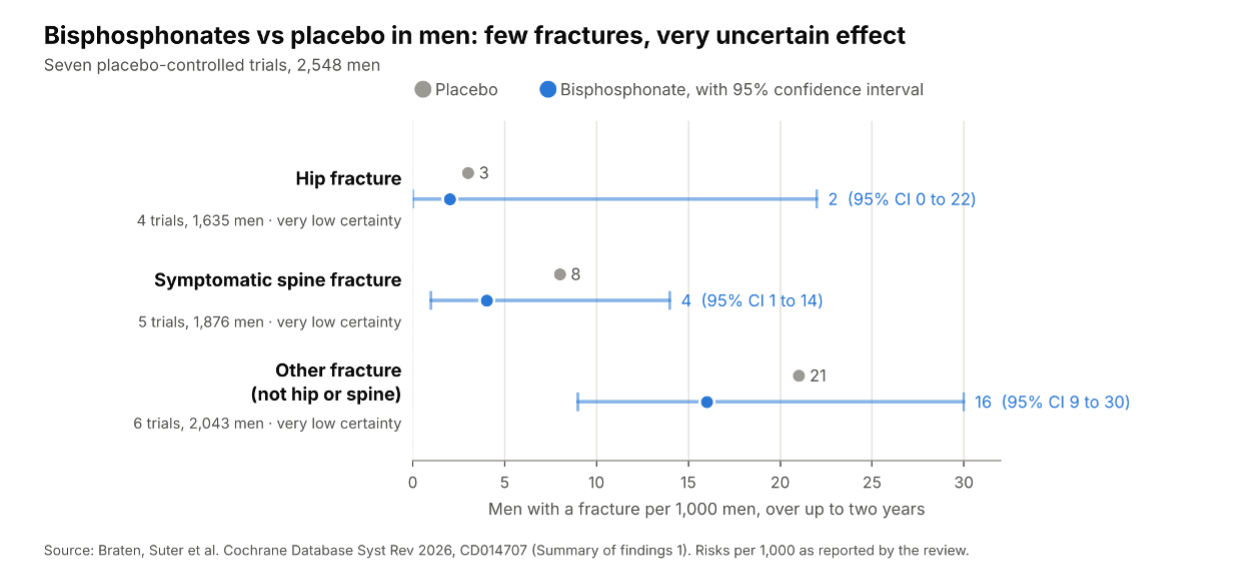
The 17 trials included men with an average age of 52 to 73 years. Most trials were small, and none reported results for men beyond two years. Our main comparison was bisphosphonates versus placebo (7 trials, 2,548 men).
With bisphosphonates, slightly fewer men had a hip, spine or other fracture than with placebo, but the differences were tiny: 1 to 5 fractures per 1,000 men over up to two years (Figure 2). Fractures were so rare that four trials with 1,635 men recorded only four hip fractures in total – two in each group. Our certainty in all fracture results is therefore very low.
On the safety side, bisphosphonates probably do not cause more adverse events or serious adverse events than placebo (moderate certainty). The trials were too small and too short, however, to detect rare but serious harms such as osteonecrosis of the jaw or atypical femoral fractures.
For the other drugs – PTH or PTHrP analogues such as teriparatide and abaloparatide (4 trials, 569 men), denosumab (1 trial, 240 men) and romosozumab (1 trial, 244 men) – the picture was the same: very uncertain effects on fractures.
The only clearly “positive” result concerned radiographic vertebral fractures, that is, deformities seen on X-ray that the patient does not notice: 22 versus 48 per 1,000 men with bisphosphonates versus placebo. This is a surrogate outcome with unclear clinical meaning, and the certainty was again very low.
So, what should we conclude?
The main finding of the review is an absence of evidence. After 17 trials and more than 4,000 men, we cannot say whether bone medicines prevent fractures in men. This is not the same as showing that they do not work. It means that the trials done so far are too small, too short and too poorly reported to answer the question. At the same time, it suggests that any benefit is probably modest: if these drugs had a large effect on fractures in men, a clearer signal would most likely have shown up by now. And because fractures were rare in the trials, even a real effect would mean only a handful of fractures prevented per 1,000 men over two years.
In practice, fracture prevention in men rests on two shortcuts: results borrowed from trials in women, and improvements in bone mineral density. Neither is solid ground. Men fracture later in life and fall less often and differently than women, and a better DXA result does not reliably mean fewer fractures.
What does this mean for the clinic? It does not mean that a man with a fragility fracture should never receive bone medication. But we should be honest that the benefit is uncertain, discuss this openly with the patient, and give fall prevention and other non-drug measures at least as much attention as the prescription.
Thank you
A review like this is pure teamwork. A warm thank you to Lars, who carried the project from the first draft to the very last revision, to Sami Hartzell for the many hours of hands-on work, and to Renea Johnston for her careful methodological work. Rachelle Buchbinder at Monash University and Teppo Järvinen at FICEBO were the minds behind the project – their experience and guidance kept us on course and brought the review across the finish line. Thanks also to Diane Horrigan for the literature searches, to Sheila Cyril for her editorial support, and to the Cochrane editors and peer reviewers for their constructive comments. Norwegian and Finnish hands at the front, steady support from Down Under – it has been a pleasure. Takk, kiitos and thank you!
Read the review
Braten LC, Suter C, Johnston RV, Hartzell SA, Järvinen T, Buchbinder R. Pharmacological therapies for the prevention of fractures in men. Cochrane Database of Systematic Reviews 2026, Issue 9. Art. No.: CD014707. DOI: 10.1002/14651858.CD014707.pub2 · PubMed


Stay up to date
Follow FICEBO on social media to stay in the loop with our latest updates.
